
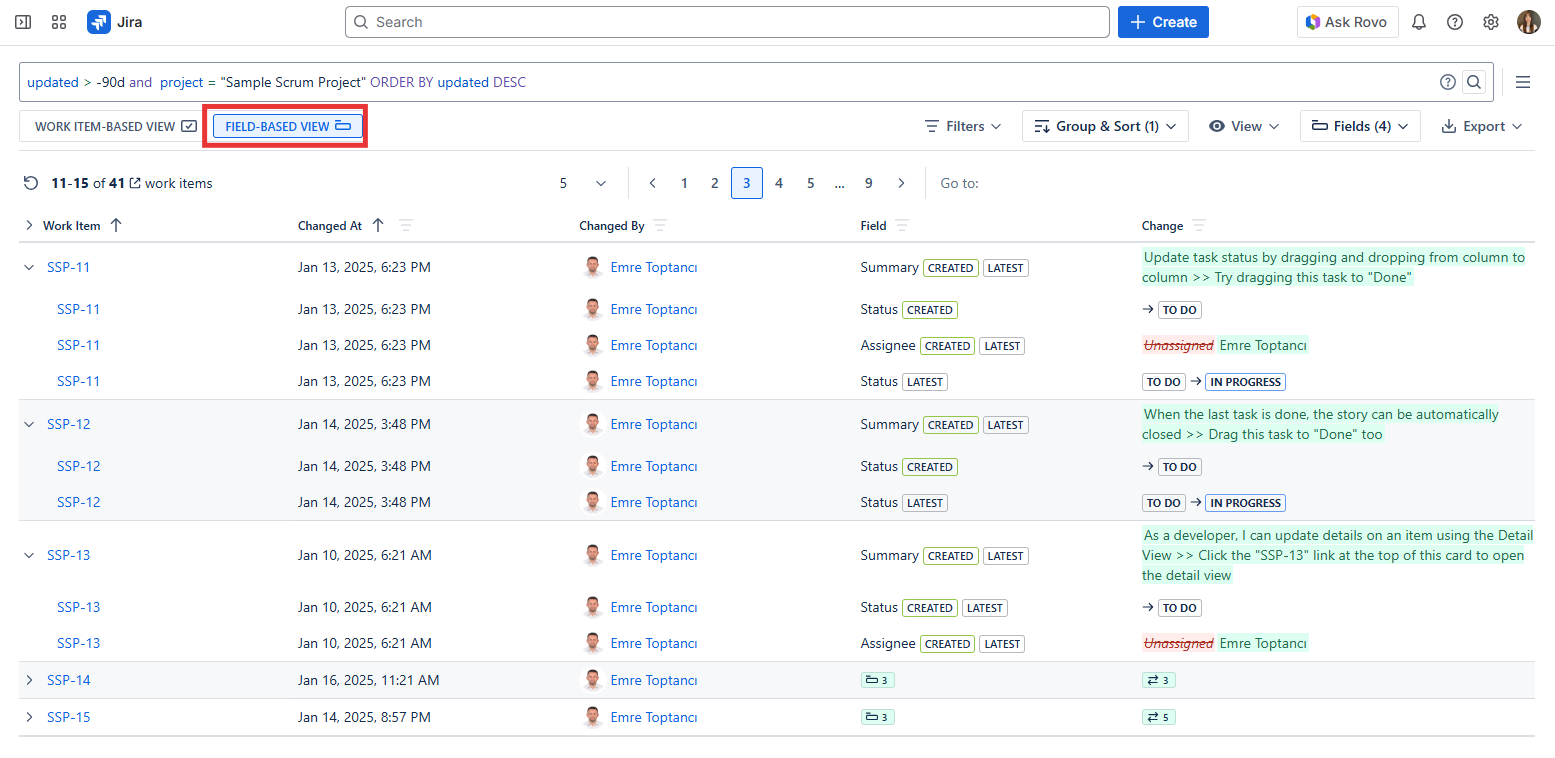
The Field–Based View shows the work item history in a field-focused manner. In this view, field names and their changes are displayed as columns, making it easier to track how specific attributes have evolved over time.
Each row in the report represents a change on a single field of a single work item at a given time. Even if multiple fields are updated simultaneously, for example, through a transition screen, each field change is listed in a separate row.
This layout provides a more granular view of changes and is particularly useful when you want to analyze the lifecycle of individual fields across multiple work items.
Field Filter
The Field Based View includes a Field Filter that lets you control which fields are visible in the report. You can check or uncheck fields to show or hide them without affecting your field selection. This is useful when you have selected many fields but want to temporarily focus on just one or two.
Change Filter
In addition to the Field Filter, the Field Based View provides a Change Filter that lets you define rules on the Change column. You can add up to 20 filter rules, and all rules are combined with OR logic. This allows you to narrow down the history log to only the specific changes you are looking for, such as all transitions to a particular status or all reassignments to a specific user. (See Filter)
Difference from Work Item Based View
Unlike the Work Item Based View, where simultaneous field changes are grouped together in a single row, the Field Based View always splits every field change into its own individual row. This makes it easier to analyze a single field in isolation but means the same change event may appear across multiple rows. If you prefer to see the full context of each change event in one place, the Work Item Based View may be more suitable. (See Work Item Based View)