
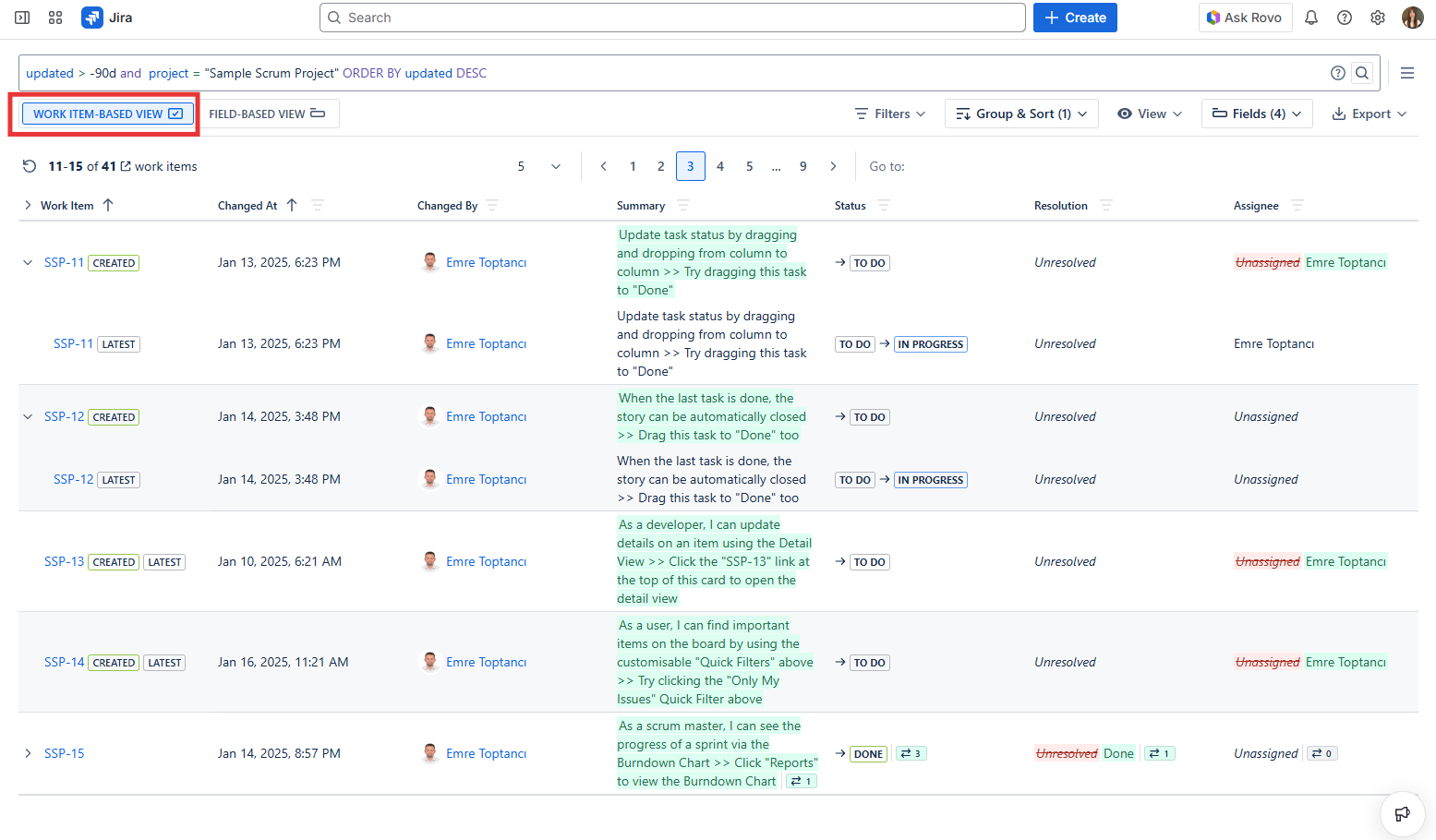
The Work Item–Based View shows the change history grouped by individual issues in a work item focused manner. Each work item appears as a row in the report, and you can expand it to see all field updates related to that work item. All selected fields are displayed as columns, making it easy to review how different attributes have evolved.
Each row in the report represents a change on a work item at a given time. A single change row may include updates on one or more of the selected fields for example, multiple field values modified simultaneously through a transition screen.
This view is especially useful when you want to follow the full timeline of changes for a single issue while also being able to compare multiple work items side by side.
Expanding and Collapsing Entries
Work items in this view can be expanded to reveal their full change history or collapsed to keep the report compact. You can use the Expand All and Collapse All options to control the visibility of all entries at once, which is helpful when working with a large number of issues.
Highlight Changes
The Work Item Based View includes a Highlight Changes option that visually marks the fields that were updated in each change row. This makes it easier to spot what specifically changed at a glance, especially when a row contains changes across multiple fields.
Filtering in This View
You can apply column-level filters directly within the Work Item Based View to narrow down the history log. Each column supports up to 10 filter rules, and rules within the same column are combined with OR logic. Filters across different columns are combined with AND logic, giving you precise control over which changes are displayed. (See Filter)
Difference from Field Based View
Unlike the Field Based View, where each field change is split into its own individual row, the Work Item Based View keeps simultaneous field changes together in a single row. This makes it easier to understand the full context of a change event. If you prefer to analyze a single field across many issues, the Field Based View may be more suitable. (See Field Based View)