Business Need
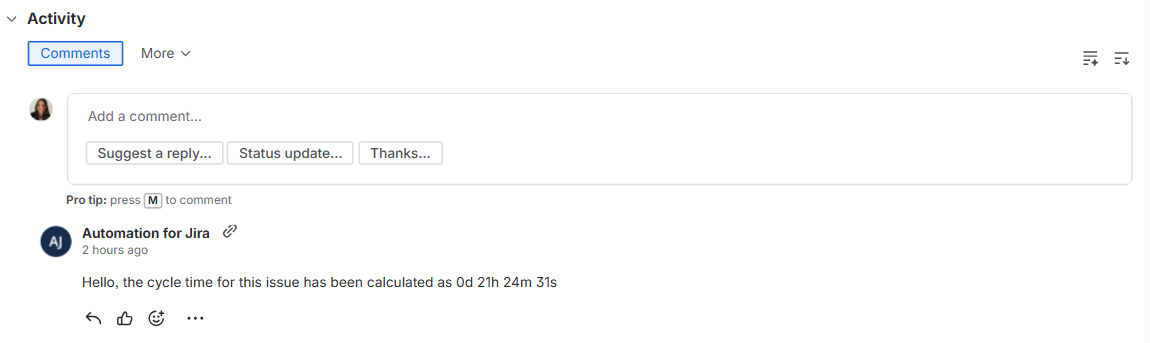
You need an automated process that calculates an issue’s cycle time and posts it as a comment when the issue transitions to the "Resolved" status.
Solution
“DURATION BETWEEN STATUSES” report type of Timepiece, combined with Jira Automation, can be used for this purpose.
Step 1: Configure and Save the Timepiece Report
First, create a Timepiece report...
-
Open the Timepiece reporting page.
-
Select the project in which the support issues reside (Let’s presume you have selected the ABC project).
-
Any filter selection at this point works. The selection made at this stage is not critical, as it will be overridden later during the automation configuration.
-
-
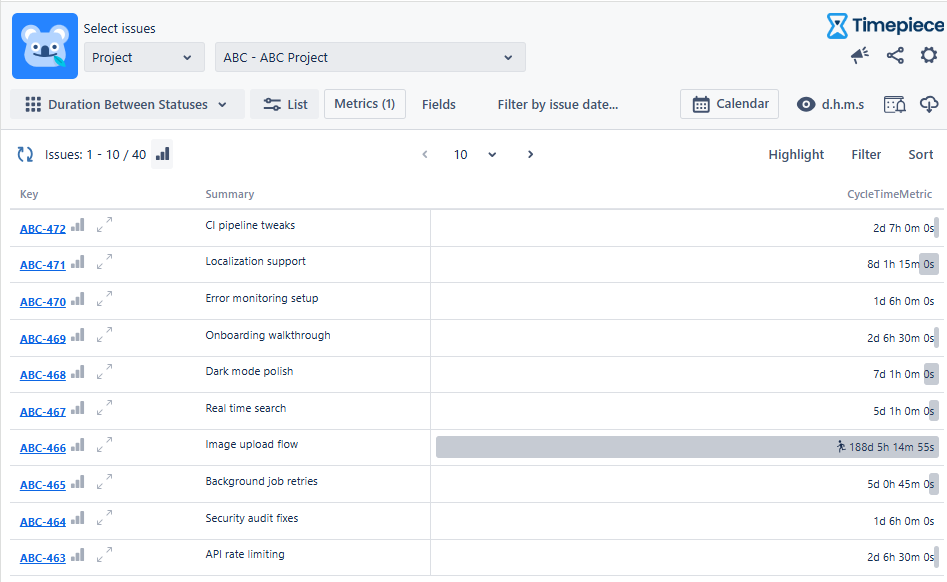
Switch to the “DURATION BETWEEN STATUSES” report type.
-
(Optional) Select your business calendar if you have one.
-
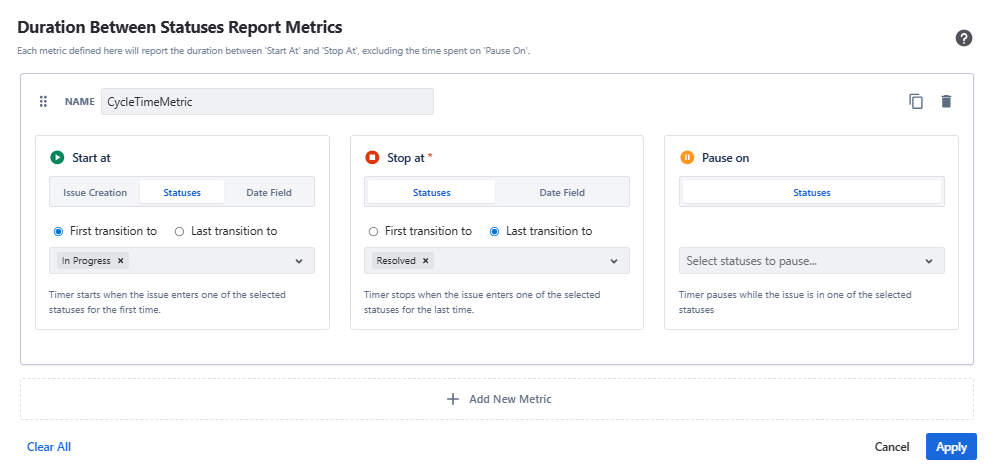
Create a metric where the start is "First transition to In Progress", and the end is "Last transition to Resolved".
-
Name this metric as "CycleTimeMetric".
-
Go to settings and save it via "Save report parameters".
-
The parameter set name should be like "ABC Project Cycle Time".
-
Make sure you select the "Share with everyone" option so others can use the param set as well.
-
Step 2: Create a Jira Automation & Set General Flow Details
Navigate to Jira Automation and start a new rule.
Before configuring the automation logic, you must define the administrative settings in the Flow Details section.
Step 3: Define Trigger and Conditions
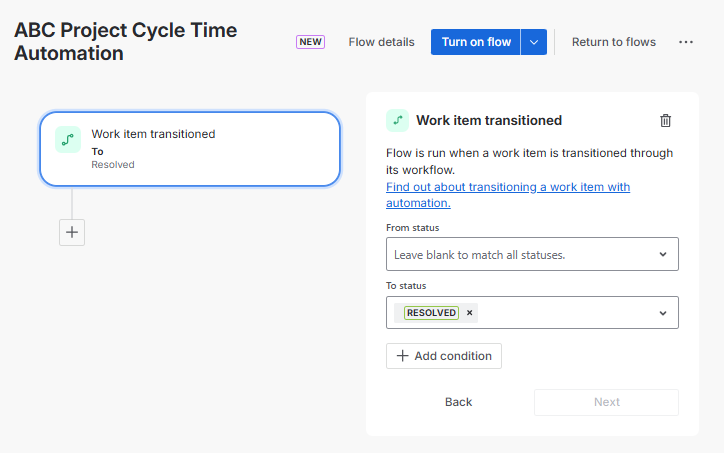
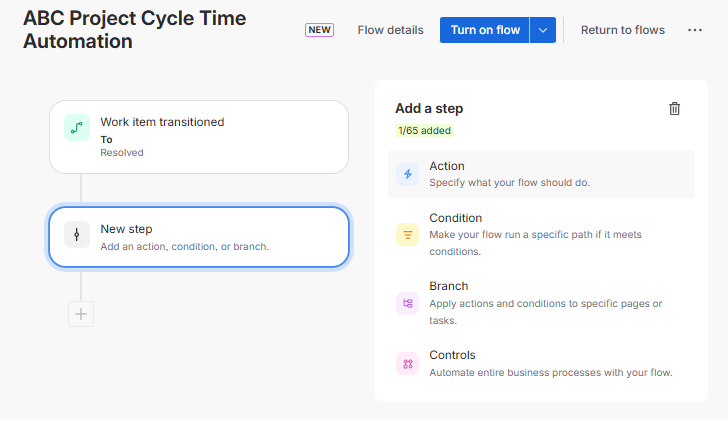
Use the “Work item transitioned” trigger and set it to fire when a work item moves to the "Resolved" status. Since our goal is to write the cycle time on an issue when the work is completed, we initiate the automation at this specific transition.
Step 4: Add Action - Timepiece: Run Report
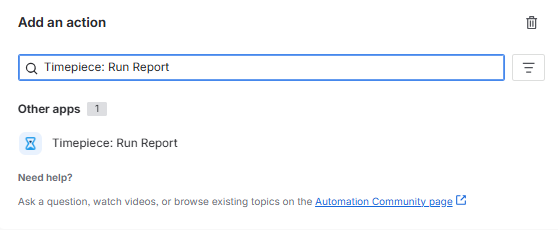
After defining the trigger and conditions, add a “Timepiece: Run Report” action that will fetch the required data from Timepiece.
-
Select the report (Parameter Set) you created for this automation in the Report Settings field. Ensure that the report has been previously saved using the “Save Report Parameters” option.
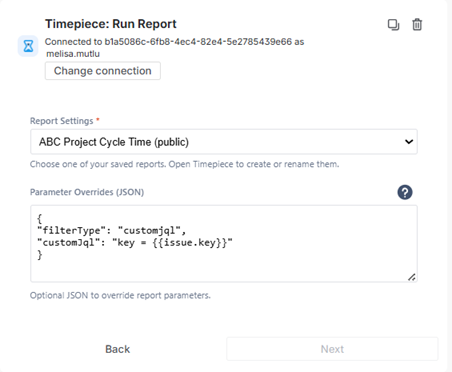
Parameter Overrides
Override some report parameters with a custom JSON. We’ll override the report filter so it returns data only for the issue that triggered the automation, which is defined by ({{issue.key}}). It ensures the automation fetches the unique cycle time for that exact issue rather than a general dataset.
Parameter Overrides: { "filterType": "customjql", "customJql": "key = {{issue.key}}" }
Step 5: Add Log Action (Optional)
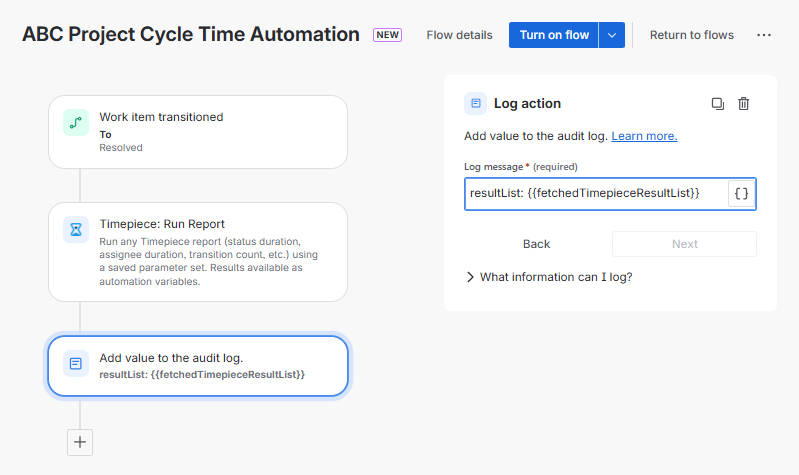
Add a Log Action to your flow. This step is necessary if you want to monitor the automation and is helpful for debugging in the event of an error.
This action writes the entire dataset returned from the report as a log output, allowing you to see all available data at once.
Log Message: resultList: {{fetchedTimepieceResultList}}
Note: For more details about the logging and debugging, see the documentation.
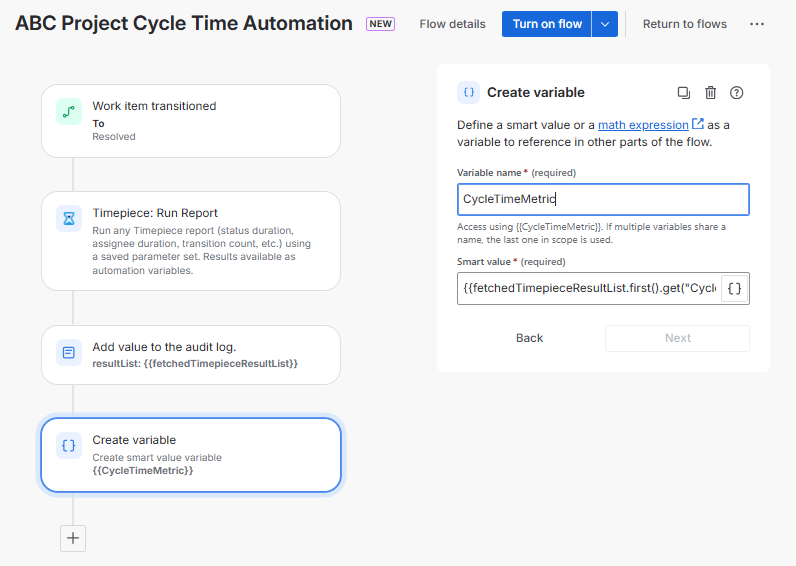
Step 6: Create Variable
In this step, we extract the 'CycleTimeMetric' duration from the dataset and assign it to the CycleTimeMetric variable so we can use it in later actions. This converts the detailed report output into a simple, portable format, making it easy to reference and display this specific duration in the final comment on the work item.
Variable Name: CycleTimeMetric
Smart Value: {{fetchedTimepieceResultList.first().get("CycleTimeMetric")}}
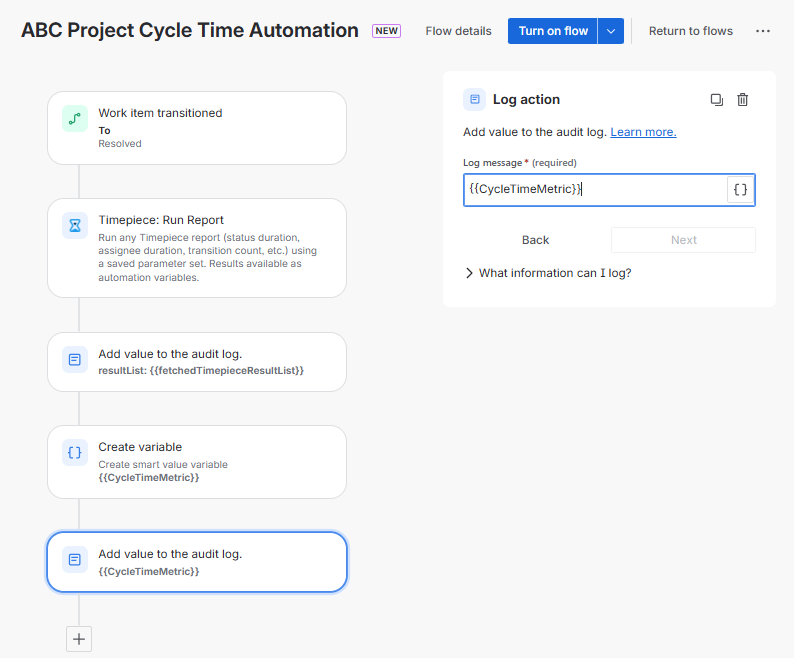
Step 7: Add Log Action (Optional)
In this step, we log the value of the {{CycleTimeMetric}} variable to the audit log. This acts as a checkpoint to verify that the duration has been correctly captured from the report, ensuring the automation has the accurate data required before proceeding to the final comment step.
Log Message: {{CycleTimeMetric}}
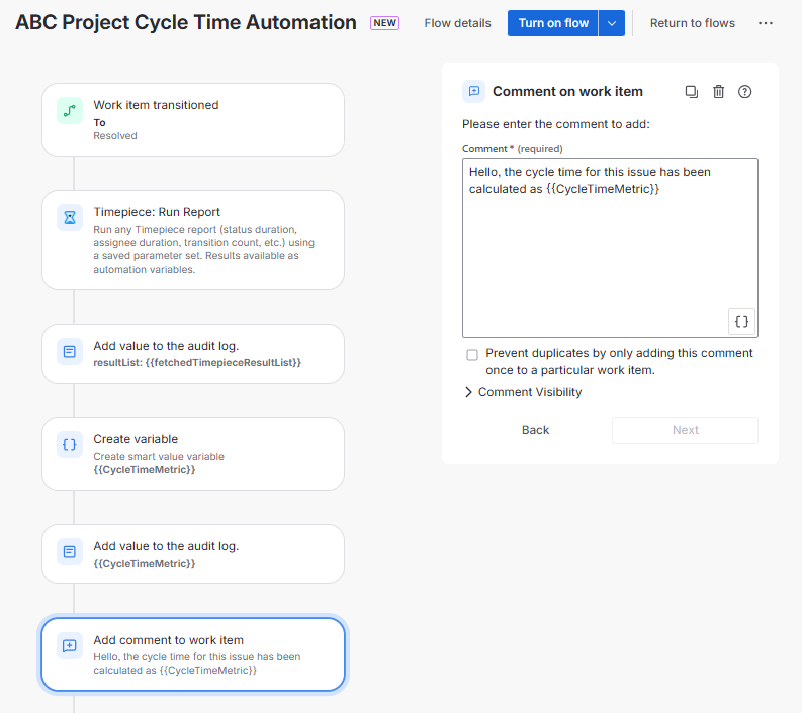
Step 8: Add Comment To Work Item
In the Comment on work item step, we post the final results directly to the issue as a comment. Using the data retrieved from the Timepiece app, this comment explicitly states the exact cycle time the issue spent from 'In Progress' to 'Resolved', providing immediate visibility into the completion duration for that specific task.
Add a comment for this automation:
Hello, the cycle time for this issue has been calculated as {{CycleTimeMetric}}
Step 9: Enable the Rule
Click the "Turn on rule" button to activate the automation.
Once active, your automation will automatically post the calculated duration as a comment on issues that transition to 'Resolved', providing visibility into how long it took for each ticket to be completed.